Enterprise AI Series
Why We Give Away the AI Agent Governance SDK for Free
Open-Source AI Governance: What It Means for Enterprise AI Compliance, Audit Trails, and Runtime Trust
Published on


Every AI agent governance vendor in this space follows the same playbook. Lock the product behind a discovery call. Gate the SDK behind a proof-of-concept engagement. Make sure nothing runs until a contract is signed.
We think that is exactly the wrong model for a category that is still being defined.
OpenBox gives the AI agent governance SDK away for free under the MIT license. That is a deliberate choice, and it reflects a specific belief about what AI governance actually is, how it needs to work at runtime, and why late-stage distribution creates a structural problem that no amount of enterprise polish can fix.
Governance that only reaches teams with large procurement budgets is not governance. It is risk transfer to the teams who could not afford the contract.
The Selling Model Is the Problem
There is a version of enterprise software where gating access makes sense. The product is complex to deploy, requires deep customization, and delivers value only after weeks of professional services engagement. In that context, a sales-led motion is a reasonable distribution strategy.
AI governance is not that product. Or it should not be.
Governance infrastructure needs to be embedded in agent systems from the earliest stages of development. Not retrofitted. Not bolted on in the quarter before a compliance deadline. The moment a developer registers an agent and starts running sessions, the governance record begins. Every decision made by that agent, every governance decision issued, every change to the agent's trust posture, all of it matters from day one. Not from day ninety, when the contract finally clears procurement.
The sales-led model creates a structural lag. Governance arrives after the architecture is set, after the agent is in production, and often after something has already gone wrong. At that point, governance becomes forensics, not prevention.
We built OpenBox to be embedded in the orchestration layer, not appended to it. That design intention only delivers its value if the SDK is in the developer's hands early enough to matter.
Open-Source vs. Proprietary AI Governance: At a Glance
Open-Source SDK (OpenBox) | Proprietary / Sales-Led | |
Access model | Free, MIT licensed | Sales call + enterprise contract |
Time to first agent | Same session as install | Weeks to months |
Audit trail starts | First SDK session | Contract start date |
Behavioral history | Accumulates from day one | No pre-contract baseline |
Dev. integration | Embedded during build | Retrofitted at deployment |
Governance record | Complete from first use | Gap before contract begins |
What’s the Difference Between Governance at Development Time vs. Production?
Consider what OpenBox actually records. Every time the platform evaluates an agent session, it captures a governance event containing:
Timestamp, agent identity, event type, and the verdict issued
Reason for that verdict, along with the workflow and run identifiers needed to trace the execution
For approval workflows: who approved or denied the request, when, and the expiration window
Every one of those events is recorded in an immutable audit trail. Records cannot be modified after creation.
Every change to an agent's Trust Score is also recorded: the previous score, the new score, the Trust Tier before and after, the type of change that triggered it, the explanation, and whether the evaluation was triggered by the system or a user.
Each session's governance events are cryptographically signed, producing a tamper-evident proof certificate. This is audit infrastructure designed for production accountability, not log aggregation.
An enterprise team that starts with the free SDK begins accumulating its governance record from the first session, not from the date its contract begins.
When governance arrives at month six of a project that shipped at month three, none of this history exists for the first half of the agent's operational life. That gap does not close. The audit trail starts when the SDK starts.
There is also a behavioral dimension to this gap. The Trust Score OpenBox computes is a composite of three weighted components:
Risk Profile Score: 40% of the total Trust Score
Behavioral compliance: 35%
Alignment: 25%
The Behavioral component is updated continuously based on runtime compliance. A minor violation reduces it by 5 points (a 1.75-point reduction in overall Trust Score); a critical violation reduces it by 25 points, an 8.75-point reduction in overall Trust Score.
Recovery is gradual. The Behavioral component recovers at one point per day for agents in Tiers 1 through 3, and 0.5 points per day for agents in Tier 4, which translates to roughly 0.35 points per day of Trust Score recovery for most agents. The behavioral history that enables meaningful trust assessment is built over time, through consistent operation. It cannot be simulated retroactively.
What the Free AI Agent Governance SDK Actually Enables
When a developer can install the SDK and register an agent within the same afternoon they start building, the runtime agent governance layer becomes part of the development feedback loop instead of a compliance event. This is a meaningful operational difference.
OpenBox integrates directly with the agent frameworks teams are already using. The SDKs cover LangGraph, LangChain, Mastra, Temporal, and Deep Agents, with additional integrations for CrewAI, Cursor, n8n, and OpenClaw in active development. Availability timelines for integrations not yet generally available are subject to change; developers should verify current status at docs.openbox.ai. The integration model is designed to wrap existing agents rather than require teams to rebuild them. That is the right abstraction. Governance should be a layer added to a working system, not a reason to redesign one.
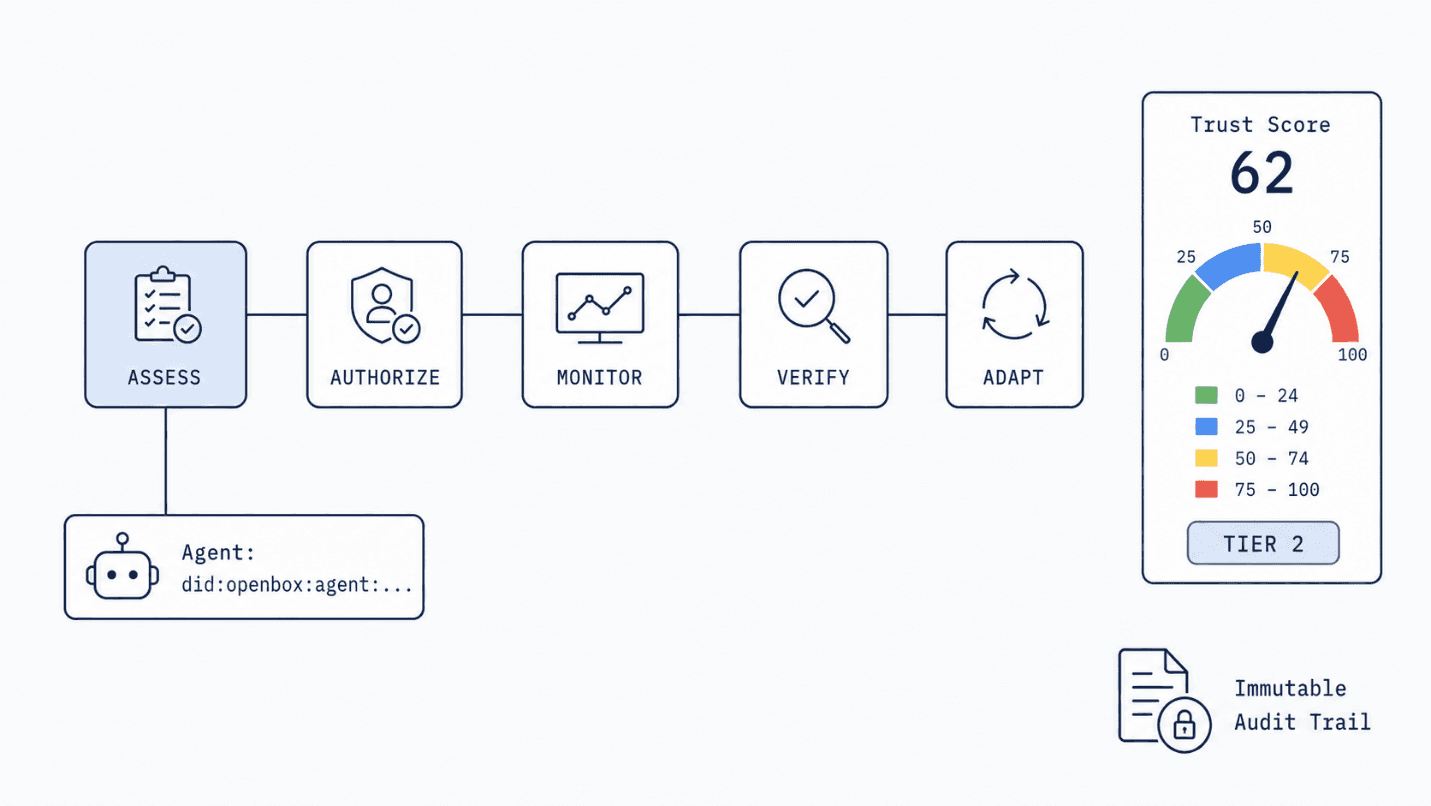
But the integration being technically easy is not sufficient if the decision to integrate requires a procurement event. A free SDK eliminates that barrier. The developer can add the OpenBox layer to their existing workflow, register their first agent, and observe how the Trust Lifecycle actually behaves against their real workloads:
Assess: produces a Risk Profile Score based on 14 parameters across Base Security, AI-Specific, and Impact categories
Authorize: configures guardrails, OPA/Rego stateless permission checks, and behavioral rules
Monitor: provides real-time observability
Verify: enables compliance-grade verification and post-hoc review of agent decisions
A developer who has run through this cycle once, in development, against their own agent, understands governance at a systems level that no sales presentation can replicate. They have seen the Trust Score move in response to real behavior. They have observed what the Adapt phase looks like when trust evolves over time. That understanding changes how they architect for production.
The Technical Case for Early Governance Integration
The Risk Profile Score is the component of the Trust Score most directly tied to the agent's inherent risk posture. It is static unless re-assessed. It is produced during the Assess phase, scored against 14 parameters across three weighted categories: Base Security at 25 percent, AI-Specific factors at 45 percent, and Impact at 30 percent.
The Risk Profile Score shapes the initial Trust Tier: a higher score indicates lower inherent risk and a higher Trust Score ceiling. The tiers break down as follows:
85-100 (Low Risk) → Tier 1-2: Fully autonomous operation; suited for log reading and report generation
55-75 (Medium Risk) → Tier 2-3: Mostly autonomous; appropriate for internal automation and data processing
25-45 (High Risk) → Tier 3: Approval gates apply to sensitive operations, including customer data handling and external API calls
0-20 (Critical Risk) → Tier 3-4: Human-in-the-loop oversight applies to most operations; appropriate for production administration and autonomous financial trading
This tier assignment is consequential. It shapes the governance posture the platform applies to that agent's actions throughout its operational life. An enterprise team that configures these parameters in development, rather than at procurement time, has the opportunity to understand how their agent's inherent risk profile will interact with OpenBox governance controls before anything reaches production.
The Agent Settings dashboard exposes the full parameter set: Base Security, AI-Specific, and Impact values that produced the current Risk Profile Score. Teams can inspect and adjust these parameters, recalculate the score, and observe the resulting Trust Tier before the agent handles a single production request. Each agent is also assigned a stable, deterministic distributed agent identifier of the form did:aip:<uuidv5>, using the AIP (Agent Interaction Protocol) DID method. This identifier persists across key rotations and appears in the audit record for every signed governance request.
That calibration exercise requires access to the SDK. It cannot be done in a slide deck or a vendor demo environment. It requires a real agent, running against real parameters, with a real Trust Score that reflects the actual risk profile of the system being built.
Why Is Open-Source Governance Important for Compliance?
There is a framing error embedded in the sales-led governance model. It treats governance as a premium product, something that sophisticated enterprises purchase after they have already deployed agents and encountered the operational consequences of uncontrolled autonomy. Governance as a remediation.
We think that framing is wrong in a way that has consequences beyond business model strategy. If governance is priced as a luxury, the teams that skip it are not making an irrational choice. They are making the economically rational choice given the constraints they face. And when those agents cause harm, the absence of governance infrastructure makes it extraordinarily difficult to understand what happened, why it happened, and how to prevent recurrence.
The organization audit log in OpenBox tracks policy changes, guardrail configuration changes, agent session events, risk configuration changes, goal alignment setting changes, role assignments, and security events. Entries capture the outcome of each event: success, failed, denied, warning, approved, or allowed.
The log is filterable by date range, event type, actor, result, and free-text search. Export is on-demand in CSV or Excel format.
None of this matters if the governance layer was never deployed. The audit trail is complete only if the agent has been operating within the trust framework from the start.
Governance that arrives too late is governance that does not work. The category we are building requires that the SDK be the first thing a developer reaches for, not the last.
The Category Belief: Governance as Enterprise AI Infrastructure
Building a category requires making a bet that the market does not yet reflect. The bet we are making is this: autonomous AI agents operating in production will require governance infrastructure as a standard component of enterprise architecture, the same way logging, authentication, and access control are standard components today.
That belief has a practical implication. If governance infrastructure is to become standard, it cannot be distributed through a sales process that takes a quarter to complete. It needs to be available at the point of decision, which is when a developer is building their first agent and choosing which layers to include.
The free SDK is how we participate in that decision. Not by competing on feature slides or analyst quadrant positioning, but by being present in the build environment when the architectural choices are being made.
The enterprise buyer who eventually formalizes a relationship with OpenBox will have already done the work. They will have seen the Trust Score operating against their real agents. They will have watched all four OpenBox governance decisions (ALLOW, BLOCK, HALT, and REQUIRE_APPROVAL) applied to their actual workloads. They will have built the organizational muscle for understanding what each verdict means in the context of their specific risk profile. By the time the commercial conversation begins, an operational relationship is already in place.
That is the only way to build this category correctly. Not by convincing procurement that governance is valuable. By making governance so embedded in how agents are built that the question of whether to govern never comes up, because it was never in question.
Get Started: Build With the Free AI Agent Governance SDK
We are slightly contrarian about the go-to-market norms in this space. Most governance vendors treat their product as a procurement event. We treat it as an infrastructure decision that should be available at development time, without friction, without a sales call, without a contract.
The SDK is free because the alternative is an enterprise AI landscape where governance is the exception rather than the default. A landscape of that kind is worse for every organization deploying agents, and worse for the broader project of making autonomous AI systems operationally trustworthy.
We know which outcome we are building toward.
To see the Trust Lifecycle in action against your own agents, get started at docs.openbox.ai. No sales call required.