Governance Engineering Series
The EU AI Act has a deadline.
What engineering teams need to build before AI governance becomes a production requirement.
Published on

Most writing about the EU AI Act is written for lawyers. It explains what obligations exist. It does not explain how to satisfy them in a production system. This is written for CTOs and engineering leads who need to translate statutory language into engineering requirements before their deadlines arrive.
The obligations covered here are not abstract. They map to specific system behaviors: what your agents must emit, when a human must be in the decision loop, and what your audit record must contain. Getting these wrong is not a compliance nuisance. Under the Act, high-risk AI systems that lack the required controls face penalties of up to 3% of total worldwide annual turnover (EU AI Act, Article 99(4)). Providers of general-purpose AI models face separate fines of up to 3% under Article 101 — a distinct obligation applying to model developers, not to enterprises deploying agents built on those models.
1. What the Act Actually Requires
The EU AI Act categorizes AI systems by risk level. Fintech applications that make or influence credit decisions, insurance underwriting, employment screening, or access to essential services are classified as high-risk under Annex III. If your agents touch any of these domains, the following obligations apply.
Article 9: Risk Management System
High-risk AI systems must maintain a continuous risk management system throughout the entire lifecycle. This is not a one-time assessment document. It is a running system that identifies residual risks, applies mitigations, and produces evaluable evidence that controls are operating as designed. Static risk registers do not satisfy this requirement.
Article 12: Logging and Record-Keeping
High-risk AI systems must automatically log events throughout their operation. The logs must enable post-deployment monitoring, facilitate investigations, and support audits. Critically, under Article 26(6), deployers must retain the automatically generated logs for a period appropriate to the intended use of the system, or a minimum of six months where no sectoral law specifies otherwise. Logs that can be modified after the fact do not satisfy this requirement.
Article 13: Transparency to Deployers
Deployers of high-risk AI systems must receive information sufficient to interpret the system's outputs and exercise meaningful oversight. This requires that your system produce structured, machine-readable records of how decisions were made, not just the decisions themselves.
Article 14: Human Oversight
High-risk AI systems must be designed to allow natural persons to effectively oversee the system during its use. This means oversight must be a functional capability, not a policy statement. The system must be able to halt autonomous operations and route decisions to a human when the risk profile of an action exceeds defined thresholds.
Article 50: Transparency for AI-Generated Content
Systems that generate or manipulate content must mark that content in a machine-readable format that allows detection of its AI origin. In practice, this means any output produced by an agent and delivered to an end user must carry provenance metadata. Verbal attestation in a terms document does not satisfy this.
2. Why Existing Approaches Do Not Satisfy These Requirements
The gap between documented policy and operative compliance is the core engineering problem. Most organizations have written policies. Very few have systems that enforce those policies at runtime, record the enforcement decisions in a tamper-evident format, and route specific actions to human review before execution. Consider the most common current-state patterns:
Logging that captures inputs and outputs but not the governance decision and its rationale does not satisfy Article 12. The record must show what evaluation occurred, not just what happened.
Risk assessments that are performed once at model deployment and not updated as the agent's behavior evolves do not satisfy Article 9's continuous requirement.
Human oversight implemented as a manual review queue that can be bypassed by configuration or operator choice does not constitute a system designed for oversight under Article 14.
Content provenance managed through application-layer conventions rather than signed, structured metadata is not reliably detectable and does not satisfy Article 50.
The common failure mode is treating compliance as a documentation layer applied on top of a system that was not designed with these requirements in mind. The Act does not require documentation of what your system does. It requires that the system itself behave in ways that are governable, observable, and auditable.
Auditability without enforcement is not compliance. The obligation is that the system behaves correctly, not that you can explain afterward why it did not.
3. The Systems Problem
Embedding compliance controls into AI agent systems is fundamentally different from embedding them into traditional software. Traditional software executes deterministic logic. An agent interprets context, selects actions, and operates across extended multi-step workflows. The control problem is stateful. An agent that behaves compliantly on step one may take a non-compliant action on step four based on intermediate results that were not anticipated at configuration time.
This means governance cannot live in a wrapper that only evaluates individual requests in isolation. It needs to evaluate action sequences, detect behavioral patterns that emerge over time, and maintain an accurate, continuously updated model of the agent's risk posture. The control layer must be integrated into the execution layer, not appended to it.
EU AI Act Requirements Mapped to Engineering Obligations
Statutory Requirement | Engineering Obligation | Common Gap |
Art. 9 Risk Management | Continuous behavioral monitoring with updatable risk parameters | One-time risk assessment, no runtime tracking |
Art. 12 Logging | Immutable, structured event log with governance decisions and rationale | Application logs without enforcement context |
Art. 14 Human Oversight | Enforceable HITL routing with pre-execution approval gates | Manual review queues that are bypassable |
Art. 50 Content Provenance | Machine-readable provenance metadata on agent-generated outputs | Verbal policy statements or application-layer conventions |
4. What Your System Needs to Build
The following are the concrete engineering requirements derived from the Act. These are not vendor-specific. They are the capabilities any compliant system must implement.
4.1 A Trust Score That Updates Continuously
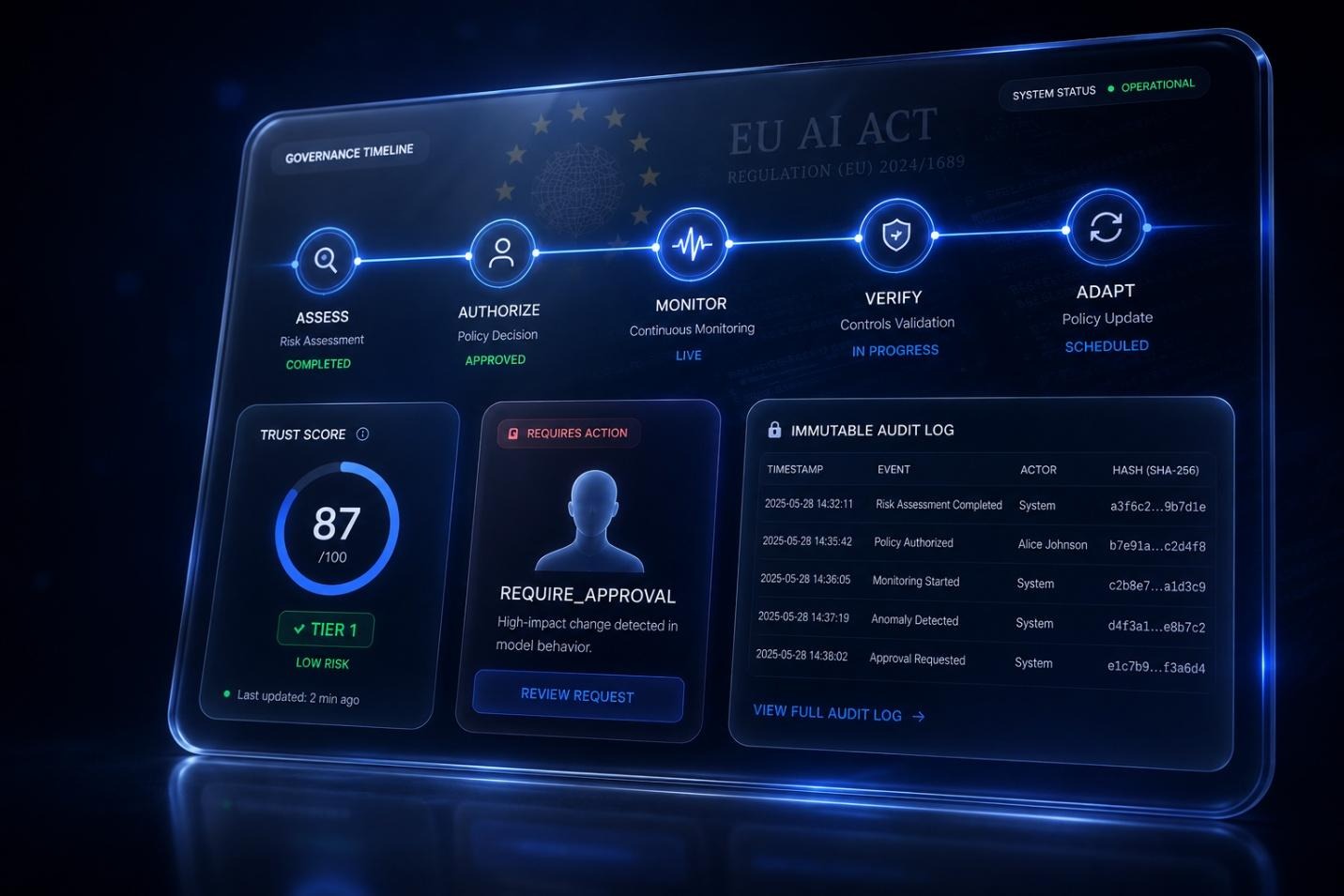
Satisfying Article 9 requires a running quantification of each agent's risk posture that reflects both its static configuration and its runtime behavior. A score calculated once at registration is insufficient. The system must recalculate risk as behavioral evidence accumulates and must adjust controls automatically when the composite Trust Score crosses a Trust Tier boundary. OpenBox maintains a Trust Score for each agent on a 0-100 scale, derived from three continuously updated components: Risk Profile Score (40% weight, from the Assess phase), Behavioral compliance (35% weight, updated in real time as violations occur), and Alignment with stated goals (25% weight, updated per session). An agent's initial Trust Tier is determined by its Risk Profile Score — the static assessment of inherent risk configured at registration. The running composite Trust Score, which incorporates behavioral and alignment data, then drives tier adjustments over time as those mappings are enforced automatically.
4.2 Hard Behavioral Constraints at Execution Time
Policy documents that describe prohibited agent behaviors do not prevent those behaviors. The constraint must be enforced at the point of action, before the action executes. This means your governance layer must sit inside the execution path, not outside it.
OpenBox’s authorization pipeline enforces hard constraints on agent actions. When an agent attempts an action, the platform evaluates it through guardrails, OPA policies, and behavioral rules in sequence, and issues one of four governance verdicts: ALLOW, BLOCK, HALT, or REQUIRE_APPROVAL. Guardrails handle input and output validation — masking PII, blocking banned terms, filtering harmful content. OPA policies and behavioral rules then evaluate the operation against configured rules and produce the final verdict. BLOCK prevents the action immediately. HALT stops the entire session. These verdicts are not advisory. They are the mechanism by which governance actually reaches the runtime system.
4.3 Enforceable Human-in-the-Loop Gates
Article 14 requires that humans can effectively oversee AI systems. Effective oversight means the system routes specific actions to human review before executing them, and cannot proceed without an explicit approval decision. A monitoring dashboard that humans can consult optionally is not a substitute.
The REQUIRE_APPROVAL verdict in OpenBox implements this as an enforcement mechanism. When a policy or behavioral rule triggers an approval gate, the agent cannot proceed until a human approves or denies the action. The platform records who approved, when they approved, and against which governance event the approval was issued. That record is part of the immutable audit trail.
4.4 An Immutable, Structured Audit Trail
Article 12 requires logs that enable post-deployment monitoring, investigations, and audits. This means the log must record not just what happened, but what governance decision was made, why it was made, and who authorized it. The record must also be tamper-evident.
OpenBox records every governance event with full context: the timestamp, the agent identity, the event type, the verdict issued, the reason for the verdict, and, for approval workflows, the identity of the approver, the approval timestamp, and the expiration. Records cannot be modified after creation. Each session's governance events are cryptographically signed, producing a tamper-proof proof certificate that can be produced for an audit without any reconstruction.
Trust Score history is recorded separately, capturing every change to an agent's score, the previous score, the change type, and the change reason. Over time, this produces a complete, auditable behavioral history for each agent in your deployment.
4.5 Content Provenance at the Output Layer
Article 50 requires that AI-generated content be marked in machine-readable form. In a multi-agent system, this requires that provenance metadata propagate through the execution chain and attach to outputs regardless of which component in the pipeline generated them. Session-level tracking of agent activity provides the linkage between output and the agent that produced it.
OpenBox's session-level tracking and cryptographic attestation provide the execution evidence needed to substantiate content provenance claims. Every governance event in a session is cryptographically signed, producing a tamper-proof proof certificate that links decisions to the agent and session that generated them. This gives you verifiable, auditable evidence of which agent produced which output and under what governance conditions — the foundation on which a provenance case can be built, pending any additional output-layer tagging your implementation requires to satisfy Article 50's machine-readable marking obligation.
5. Operational Implications
Building these capabilities has concrete implications for how you operate your agent infrastructure. Three are worth calling out explicitly.
Governance state must be per-agent and persistent. You cannot share a single policy evaluation context across agents. Each agent requires its own Trust Score, its own behavioral history, and its own audit record.
Control changes must themselves be audited. When you modify a guardrail, update a policy, or adjust a risk parameter, that change must be recorded with the identity of the person who made it and the timestamp. The OpenBox organization audit log captures policy changes, guardrail changes, and risk configuration changes as event types, each with a result and an actor.
Exports must be on-demand and regulatorily complete. When an auditor requests records, you must be able to export structured, complete audit data for a specified time range. Point-in-time database queries that reconstruct this on demand are not equivalent to a maintained audit record.
The operational cost of building this correctly in-house is significant. More importantly, the coordination cost of keeping it correct as your agent fleet scales is ongoing. Every new agent, every new workflow, every new integration must be enrolled in the same governance framework. That is a systems coordination problem, not a one-time engineering task.
Enterprise AI risk is a systems coordination problem. The compliance burden scales with your agent fleet. Your governance infrastructure must scale with it.
Conclusion: Build the Control Layer Before the Deadline
The EU AI Act does not create an obligation to write better policies. It creates an obligation to deploy AI systems that are, by design, governable. The distinction matters. A governable system enforces its policies at runtime, maintains a continuous and auditable record of those enforcements, routes specific actions to human review before execution, and produces verifiable provenance for its outputs.
Most AI agent deployments today do not have this control layer. The governance logic either lives in documentation, in post-hoc monitoring, or in application code that cannot be updated independently of the agent. None of these satisfy the Act's requirements. None of them provide the oversight capability that regulated industries actually need.
Note on timing: a provisional agreement on the EU AI Omnibus, reached May 7, 2026 and pending formal adoption, proposes to defer Annex III high-risk system obligations from August 2, 2026 to December 2, 2027. The enforcement date is therefore subject to change. The engineering requirements described in this brief remain unchanged regardless of when that date is formalised. The gap between current deployments and compliant ones is not primarily a model problem or a data problem. It is a governance infrastructure problem. Building that infrastructure before it is required by an auditor or a regulator is the only approach that does not carry compounding remediation cost.
About OpenBox
OpenBox is an AI agent governance platform providing trust scoring, behavioral guardrails, policy enforcement, real-time monitoring, and cryptographic audit trails for autonomous AI agents deployed in production. Documentation at docs.openbox.ai. Enterprise inquiries: contact@openbox.ai.
This article relies on OpenBox documentation (docs.openbox.ai) as the primary source of authority for all OpenBox capabilities and constructs referenced herein.