Enterprise AI Series
LangSmith vs OpenBox: What's Right for Enterprise AI Teams
For engineering leads and CISOs deciding what belongs in a production agent stack: why the comparison matters less than understanding which layer each tool occupies
Published on

Most enterprise AI teams frame this as a selection decision. The framing is wrong.
LangSmith and OpenBox are not competing for the same slot in an agent stack. They are built to answer different questions. Teams that treat them as alternatives tend to discover the distinction late, during a governance audit or enterprise sales review, where the cost of the confusion is higher than a tooling swap.
This is not a feature comparison. It is an architectural clarification. The question "LangSmith or OpenBox?" is the wrong question. The right question is: which layer of your production infrastructure does each one belong in, and do you have both covered?
THE DISTINCTION THAT GOVERNS THE DECISION A development platform optimized for iteration answers engineering questions. A governance layer built for accountability answers compliance questions. Enterprise AI teams operating agents in production need both. The sequencing question is which gap creates the more immediate risk. |
WHAT LANGSMITH IS BUILT FOR
LangSmith is LangChain's agent engineering platform for building, debugging, and evaluating language model applications. It works with or without the LangChain framework and is compatible with OpenAI SDK, Anthropic SDK, LlamaIndex, and custom implementations. Its core capability is tracing every step in a chain or agent run: every prompt, intermediate call, and model output, so the engineering team can inspect what the application did and why a run succeeded or failed.
The tooling it provides is genuinely useful for the engineering workflow: structured evaluation datasets for testing prompt or model changes, run comparison to measure the impact of an iteration, and a monitoring interface that surfaces anomalies in production output. Teams building and improving AI applications get real value from the visibility LangSmith provides. Its current capabilities extend to online evaluation against live production traffic, including safety checks and quality heuristics running automatically on production traces, as well as self-hosted and bring-your-own-cloud deployment options for teams with data residency requirements.
The user LangSmith is designed for is the AI engineer or ML practitioner whose primary need is to understand and improve model behavior. Its question is: what did the application do, and how do we make it better? That is a development and quality question. It is the right question for the development lifecycle.
What LangSmith is not designed to answer is whether the application was authorized to do what it did before the action occurred. Online evaluators score outputs after they are produced; they do not enforce policy at the point of a tool invocation, API call, or data access decision. And even where evaluators can gate a release in CI/CD, they do not produce a session-level cryptographically attested proof certificate confirming that a policy was evaluated prior to execution. Those are governance questions. They require a different class of infrastructure.
WHAT OPENBOX IS BUILT FOR
OpenBox (openbox.ai) operates at the governance layer. Its core function is not to record what agents did but to enforce what agents are permitted to do, at the point of execution, before the action occurs.
The Trust Lifecycle (Assess, Authorize, Monitor, Verify, Adapt) is a governance architecture, not a pure observability architecture. Its observability capabilities exist in service of enforcement and accountability, not as a debugging or iteration tool. Guardrails enforce hard constraints on agent actions; Policies apply OPA/Rego stateless permission checks; Behavioral Rules detect stateful multi-step behavioral patterns. Together they form the authorization layer governing agent behavior at runtime. The Audit Log records not just the action but the governance event behind it: the verdict issued, the reason for it, and the agent and workflow context in which it was evaluated. Session Replay provides the governance trace: a replay and audit record of agent sessions, capturing the governance decisions evaluated during execution, not only the output itself.
The user OpenBox is designed for, extends beyond the engineering team. The compliance officer who needs to demonstrate that an agent was constrained before it acted. The CISO who needs to answer an enterprise customer's due-diligence question about what prevents the agent from exceeding its authorization. The legal team that needs an audit record structured as evidence, not as a debugging log.
Where LangSmith tells you what happened, OpenBox is the infrastructure that determines what can happen, maintaining the record to prove it.
THE OBSERVABILITY-GOVERNANCE CONFUSION
There is a systematic error in how enterprise AI teams approach this space. The error has a pattern: a team selects an observability or tracing tool, observes that it produces detailed logs of agent behavior in production, and concludes that this constitutes governance. It does not. This is the Observability-Governance Confusion. This is not a tooling mistake. It is a category error. Observability systems operate downstream of execution; governance systems operate upstream of it. No amount of downstream visibility can substitute for upstream control.
Observability logs show what happened. Governance records show what was permitted to happen, and whether those two things matched. The distinction is not semantic. It is the difference between a record produced after an action and a control evaluated before one.
The confusion surfaces in three specific contexts where observability logs fail to substitute for governance infrastructure.
Regulatory audit. A compliance examiner asking "how do you ensure your agent only accesses data within its authorized scope" cannot be answered with a trace log. The trace log shows what the agent accessed. The governance record shows what it was permitted to access and that a policy was evaluated prior to access. These are different documents. Only the second satisfies the audit requirement.
Incident investigation. When an agent acts outside expected parameters, a trace log reconstructs the action sequence after the fact. A governance trace shows whether the action was within authorized scope before execution began. The difference is whether the control existed upstream or downstream of the incident.
Enterprise customer due diligence. When a prospective customer's security team asks "what prevents your agent from accessing data outside its permitted scope," the answer cannot be a monitoring dashboard showing what the agent did. The answer is the authorization architecture: what is enforced before execution, not what is visible afterward.
Observability logs are evidence of what happened. Governance records are evidence that permission was evaluated. These satisfy different audit requirements.
Teams that use LangSmith as their governance mechanism discover this distinction during audits. The logs are detailed. The governance infrastructure is absent. The control is not there.
THE TWO-LAYER MODEL
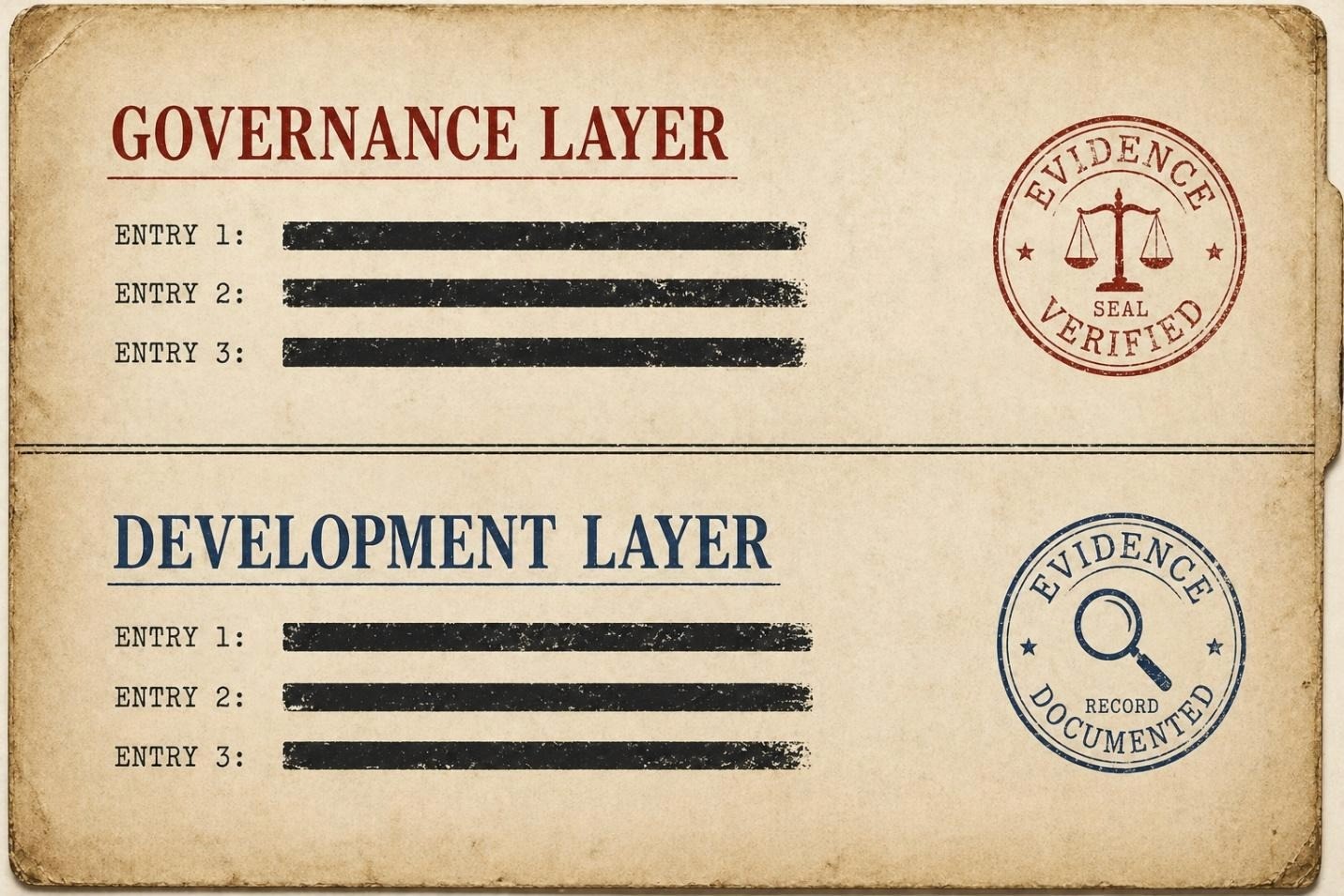
The correct frame for this decision is not selection but coverage. Enterprise AI teams operating agents in production need both layers functioning independently, serving different stakeholders, producing different artifacts.
The development layer (where LangSmith belongs) serves engineering questions. What is the agent doing? Where are the failure modes? Is a model change improving output quality? Its output is insight: trace data, evaluation results, and performance metrics that accelerate the engineering cycle.
The governance layer (where OpenBox belongs) serves accountability questions. Is this agent authorized to act in this context? Is there a policy evaluation record attached to this action? Can the authorization be demonstrated to a compliance examiner or enterprise security team? Its output is evidence: governance traces, audit logs, and policy records that satisfy the accountability requirements of production deployment.
A building security analogy makes the architecture concrete. A surveillance system records every movement in a building. Access controls determine who is permitted to enter which areas. Both are necessary for a building that must be both monitored and secured. Neither substitutes for the other: cameras without access controls produce excellent documentation of incidents that were never prevented; access controls without cameras produce authorization records with no visibility into how the system is actually used.
LangSmith is primarily a visibility layer. OpenBox is primarily an enforcement layer. An enterprise AI team that has one but not the other has a gap; the question is which gap is more urgent to close given their current deployment context.
DIMENSION | LANGSMITH / OPENBOX |
|---|---|
Primary question answered | What did the agent do and how do we improve it? / Was this agent permitted to act, and is there a record? |
Enforcement point | Primarily after execution (trace, review, and CI/CD gating on outputs) / Before execution (policy evaluation prior to agent action) |
Primary artifact | Debugging trace, evaluation dataset / Governance trace, audit log, policy record |
Core user | AI engineers, ML practitioners / Compliance teams, CISOs, enterprise security |
Production governance | Visibility into what occurred / Authorization record for what was permitted |
Audit response | Operational record of behavior / Evidence of policy enforcement |
SEQUENCING THE DECISION
For enterprise AI teams navigating this space, the practical question is not which tool to select. It is sequencing and coverage: which gap creates the more immediate risk, given your current deployment stage and customer profile.
If your primary gap is development quality and engineering velocity
The development layer is the right place to start. Tracing, evaluation infrastructure, and run comparison address the quality of what the agent produces and accelerate the iteration cycle. This is the appropriate entry point for teams in active development where the core challenge is improving model performance and debugging agent failures before production deployment.
If your primary gap is production governance and enterprise accountability
The governance layer is the right place to start. Runtime policy enforcement, execution-level audit records, and Trust Lifecycle management are the infrastructure of production-grade deployment in regulated or enterprise-customer contexts. Teams moving agents into environments where compliance obligations or enterprise security reviews exist need this layer in place before those reviews occur, not in response to them.
If both gaps are present simultaneously
Both layers are required. The sequencing question then becomes which gap creates more immediate risk. Development quality failures are visible, surfaced in engineering reviews, and correctable before they reach production customers. Governance gaps tend to surface during enterprise security reviews and compliance audits, where the remediation timeline is compressed by the commercial context in which the gap was discovered. Teams that lack governance infrastructure and are identified during a customer security review face a different category of pressure than teams that discover a model quality issue internally.
The teams that build both layers early, before a governance audit or enterprise security review surfaces the gap, find they are reinforcing rather than competing. Observability data informs governance policy tuning. Governance records provide the evidentiary structure that observability data alone cannot produce. The two layers are architecturally complementary. The market framing of them as alternatives is the confusion that creates the gap.
WHAT ENTERPRISE AI TEAMS ARE ACTUALLY DECIDING
The LangSmith vs OpenBox framing is a reasonable entry point for teams mapping the agent tooling landscape. It becomes a liability when the answer stops at "choose one."
Enterprise AI deployment carries two distinct accountability requirements that do not resolve to the same infrastructure. Engineering accountability (what the agent does, how it performs, where it fails) is LangSmith's domain. Governance accountability (what the agent is permitted to do, whether that permission was enforced before action, whether the enforcement is auditable) is OpenBox's domain. Both requirements are non-negotiable for any team deploying agents to enterprise customers or in regulated environments.
As AI agents move from prototype to production and from internal tools to external-facing deployments, the regulatory direction is uniform: enforcement at the point of execution, not observation after the fact. The teams that build this infrastructure now will not be caught constructing it under audit conditions. That constraint is not a future risk; it is the present condition of enterprise AI deployment for any team whose customers have compliance functions.
KEY TERMS
TERM | DEFINITION |
|---|---|
Observability (AI context) | The practice of capturing traces, logs, and metrics from a language model application to understand what it did and support debugging and improvement. Answers operational questions, not governance questions. |
Runtime governance | The enforcement of policy constraints on agent actions at the point of execution, before the action occurs. Distinct from observability: governance determines what can happen; observability records what did happen. |
Observability-Governance Confusion | The systematic error of treating detailed observability logs as evidence of governance. Observability records what an agent did; governance records what it was authorized to do and that authorization was enforced. |
Governance trace | An execution-level record capturing not only the agent's action but the policy evaluation that preceded it: what was permitted, what was blocked, and the authorization context. The audit artifact that observability logs do not produce. |
Trust Lifecycle | OpenBox's governance framework: Assess, Authorize, Monitor, Verify, Adapt. Each stage addresses a distinct gap in production agent accountability, from risk posture assessment through policy adaptation based on observed behavior. |
Development layer | The infrastructure serving engineering questions about agent quality and behavior: tracing, evaluation, debugging, and run comparison. LangSmith's operating layer. |
Governance layer | The infrastructure serving accountability questions about agent authorization and auditability: runtime policy enforcement, execution-level audit logs, and Trust Lifecycle management. OpenBox's operating layer. |