Technical Guide
How to Monitor AI Agents in Production: A Technical Guide
What Production Observability Misses, Why the Gap Is Structural, and What Governance Teams Must Build Instead.
Published on
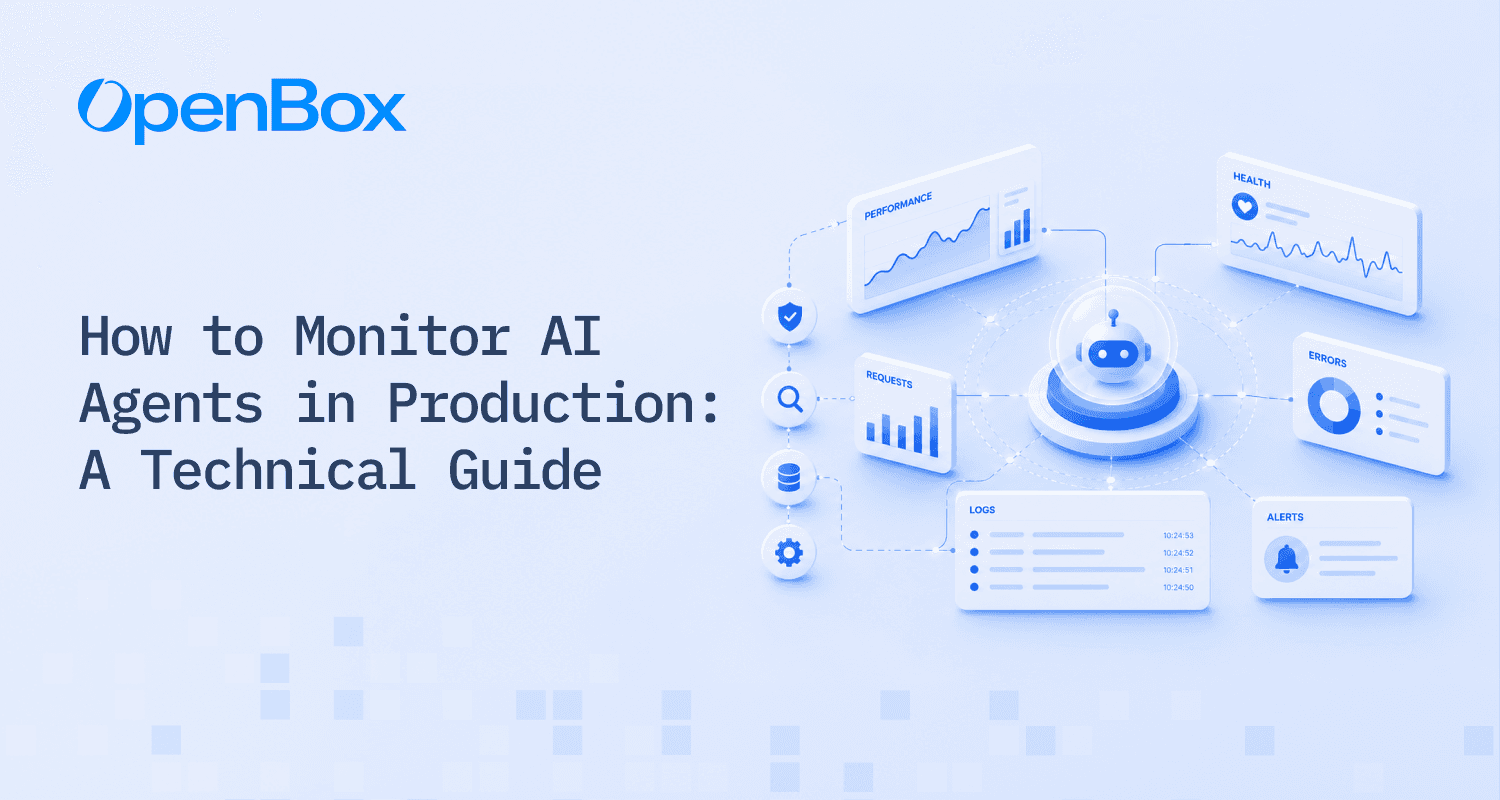

A financial services firm deploys a customer-facing agent to handle portfolio queries, account disclosures, and trade confirmation summaries. Within six weeks, the team has built a comprehensive monitoring stack: latency dashboards, error rate alerts, output logging across every session. What they do not have, and cannot see, is whether the agent's disclosures remain within the regulatory constraints under which it was approved to operate. The logs confirm the agent is functioning. They cannot confirm whether it is governed. This distinction is the central problem of AI agent production monitoring, and it is not resolved by adding more instrumentation. It is resolved by recognizing that monitoring and governance are different categories of system, and building accordingly.
The gap between these categories is structural, not incremental. More dashboards do not close it. Better alerting thresholds do not close it. More frequent log review does not close it. Each of those investments produces better evidence about what happened. None produces control over whether the agent was permitted to act as it did. A production monitoring program that cannot answer the latter question is not a governance program. It is a forensic archive.
The Observability Governance Gap
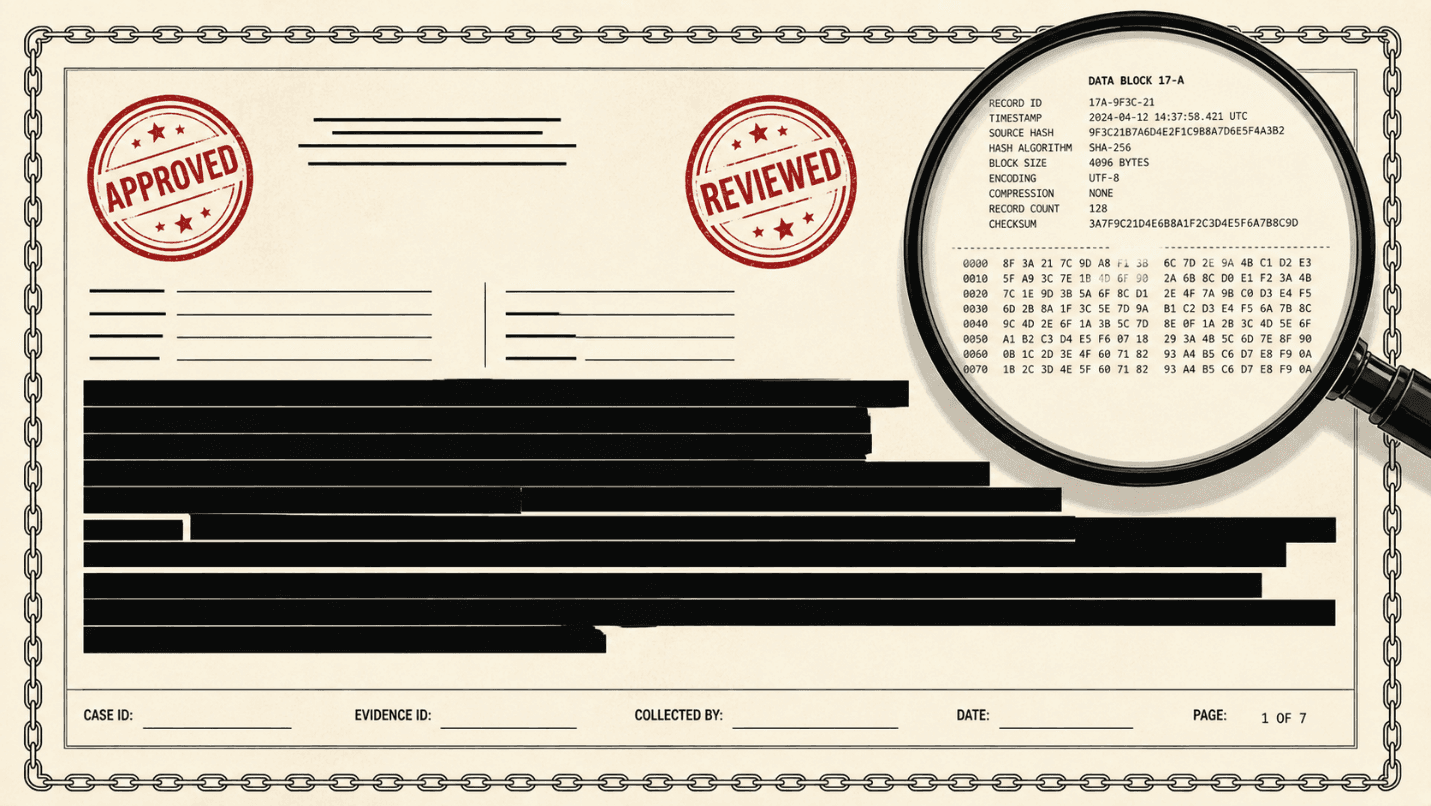
This structural failure emerges when a team instruments everything an agent does but governs nothing it decides.
The governance gap is difficult to detect because standard production metrics can appear healthy despite policy drift. Latency is within bounds. Error rates are acceptable. Output volume tracks against expectations. Standard operational dashboards do not measure whether agent behavior remains aligned with its approved governance profile. The agent is producing outputs. The question the dashboard cannot answer is whether those outputs were governed decisions or merely observable results.
The governance gap is most dangerous when an agent appears operationally healthy. A well-functioning agent running outside its approved governance envelope is a compliance exposure that no uptime alert will surface. By the time an audit or incident reveals it, the gap between what was certified and what was operating in production is measured not in configuration drift, but in decisions.
Why Instrumentation Alone Fails
Traditional software monitoring operates on a sound assumption: the system's behavior is fully described by its code. Log the inputs, log the outputs, track the exceptions, and the system is characterized. Every deviation from expected behavior is detectable in principle, because the expected behavior is fixed.
AI agents do not have this property. Their behavior emerges from the interaction between a model, a set of tools, a prompt context, a retrieval corpus, and an operating environment that shifts continuously. A model update, a new document in the retrieval index, a changed prompt template, an upstream API returning different data: any of these can shift the agent's behavior in ways that no individual output comparison will detect. The same input can produce meaningfully different outputs across sessions, and both outputs can appear within acceptable bounds, without triggering a single alert.
This is the instrumentation ceiling: the point at which adding more monitoring does not add more governance. More dashboards do not reveal whether the agent's access to customer financial data conforms to minimum-necessary disclosure requirements. More logging does not surface whether a multi-step query sequence reconstructed a protected record in ways no single-action check was configured to detect. More alerting does not validate whether the control environment that compliance reviewed last quarter still holds under current operating conditions.
Three distinctions define what production monitoring for AI agents must maintain, and which current tooling routinely collapses. Monitoring observes behavior after execution begins. Logging records evidence after execution completes. Governance determines whether the action is permitted before and during execution. The first two are retrospective by design: they produce a record of what occurred. Only the third operates at the same instant as the agent's action. Deployments that conflate these categories are measuring the output of a system they are not controlling.
What Production Governance Actually Requires
Effective runtime governance for AI agents requires three capabilities that observability tooling does not provide.
Behavioral Baseline Integrity. An agent's behavior at deployment is not its behavior in production six months later. Models are updated, retrieval corpora absorb new material, prompts evolve. Production monitoring must track drift from the behavioral baseline established at authorization, and it must do so continuously, not periodically. A quarterly compliance review that compares current outputs against a deployment-era snapshot is not behavioral monitoring. It is retrospective analysis of behavior that has already drifted. The governance gap is measurable in decisions by the time such a review runs.
Decision-Level Attestation. Every governance decision (allow, block, redact, or escalate) must produce a cryptographically signed record that survives regulatory inspection. Logging an output is not equivalent to attesting to the decision that produced it. An attested decision trace tells a regulator not what the agent produced but what controls applied, what was evaluated, and what was permitted or denied during runtime authorization. That is the unit of evidence that NIST AI RMF's MEASURE function, ISO/IEC 42001's continual improvement requirements, and the EU AI Act's Article 14 human oversight obligations for high-risk AI systems in production are converging toward. Teams without attestation-level records cannot produce that evidence under examination. They can produce logs.
Policy Continuity Validation. The policies and behavioral rules under which an agent was authorized are not self-enforcing. They require continuous validation against the agent's actual behavior in production, not sampling across representative sessions, but verification that controls are firing in the specific conditions they were configured for. A guardrail that is configured correctly but not triggering in its target conditions is not a functioning control. It is a false assurance. Policy continuity validation is the mechanism that surfaces the difference.
OpenBox as the Governance Layer
OpenBox (docs.openbox.ai) operates as the runtime governance layer for AI agents. It wraps existing agent infrastructure with minimal architectural modification and enforces governance decisions during runtime authorization rather than observing afterward. The Trust Lifecycle (Assess, Authorize, Monitor, Verify, Adapt) maps directly onto the three production monitoring requirements above.
Assess establishes the behavioral baseline that production monitoring requires. The Risk Profile Score determines the agent's Trust Tier, which defines its autonomy envelope. The composite Trust Score combines Risk Profile, Behavioral, and Alignment signals to track trust continuously over time. A financial services agent handling customer disclosures does not begin production at the same tier as an internal reporting agent with no customer data access. The baseline updates continuously as behavioral data accumulates, which means drift is measurable against a living reference, not a static snapshot.
Authorize is where the runtime governance decision is made. Runtime authorization operates through three control surfaces. Guardrails enforce hard constraints on what the agent can produce: financial disclosure limits, data exposure boundaries, prohibited content categories. Policies, expressed in OPA/Rego, encode stateless rules that map regulatory requirements into executable logic: minimum-necessary data access, role-based exposure boundaries, jurisdictional constraints on data handling. Behavioral Rules detect stateful multi-step patterns that no single-action check can surface: the agent that executes a sequence of individually authorized queries that together reconstruct a customer record beyond the scope of any individual permission. Each query passes a single-action check. The sequence does not. That distinction is what stateful multi-step detection is designed to catch. The output of every Authorize evaluation is a Governance Decision: allow, block, redact, or escalate.
Monitor is real-time behavioral observation. Observation is continuous across every session rather than sampled from a representative subset. What a regulator examining a specific session needs is the complete record of that session, not an inference from aggregate metrics.
Verify evaluates whether the agent's actions across a session remained aligned with the purpose and governance conditions under which it was deployed. It validates that the controls applied during Authorize continued to hold as behavior evolved. Did the Policies fire where they should have? Did the Behavioral Rules surface the patterns they were configured to detect? Did the Guardrails enforce what they were designed to enforce? Session Replay reconstructs the complete decision path for any session in a form reviewable by compliance teams and external auditors, producing the retrospective record that post-hoc examination requires. Verify is the structural complement to Authorize, not a substitute for it.
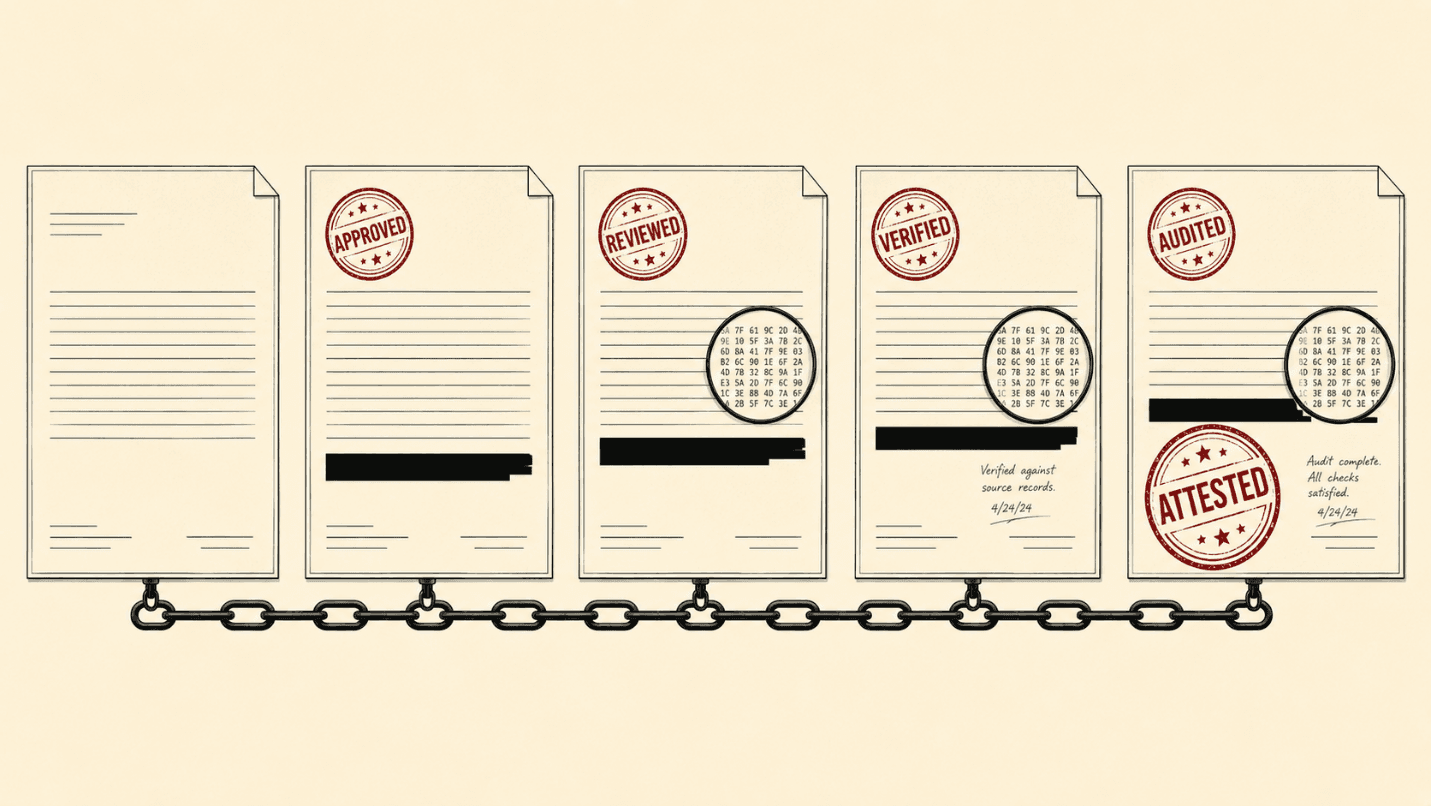
Cryptographic Attestation operates across all five stages, producing a tamper-evident audit record of every governance decision and control evaluation throughout the agent lifecycle. The attestation stream becomes the audit record itself: complete, signed evidence of what the governance layer evaluated and decided during every session, from Assess through Adapt.
Adapt is the policy update layer. Trust Scores shift as behavioral data accumulates. Guardrail configurations and Behavioral Rules refine in response to what Verify surfaces. Policies are versioned. Where the composite Trust Score crosses a Risk Profile threshold, Trust Tier reclassification can trigger re-authorization workflows that narrow or expand the agent's permission envelope based on configured governance policies. An agent that demonstrates sustained alignment gains broader autonomy. The governance posture adjusts on the signal the system produces, not on the review cycle the compliance calendar dictates.
Production Monitoring Records What the Agent Did. Governance Determines Whether the Action Was Permitted. These Systems Serve Different Functions, and One Does Not Substitute for the Other.
What Changes in Practice
The shift from instrumentation to governance changes the working posture of three groups.
For compliance teams, audit preparation collapses into a query. The attestation stream is the audit record. There is no retrospective project to reconstruct what the agent was doing when an incident is alleged, because every governance decision it made carries a signed trace in the form external examiners require. HIPAA accounting-of-disclosures, MiFID II suitability record requirements, and EU AI Act transparency obligations all resolve against the same underlying attestation log.
For engineering teams, governance becomes an infrastructure layer rather than a release-cycle gate. Policies are versioned alongside model updates. Behavioral Rules are tested and reviewed as part of the standard deployment pipeline. The compliance team and the engineering team operate against the same versioned artifacts, which eliminates the translation friction that delays every governance review and creates the documentation gaps that regulators find.
For risk and legal teams, the defensibility question changes form. The question is no longer whether the agent might have operated within its approved parameters during a period under review. The question is whether the attested record shows that it did. These are not the same question, and only one of them is answerable under examination.
The Inevitable Architecture
NIST AI RMF's GOVERN and MEASURE functions require organizations to document and validate AI system behavior in deployment, not at release. The EU AI Act's Article 14 human oversight obligations for high-risk AI systems require that oversight be effective in production. Post-hoc log review cannot satisfy that standard when the agent has already acted and the session is closed. ISO/IEC 42001's continual improvement requirements assume that governance operates continuously, not on an annual or quarterly review schedule.
These frameworks are not converging on a documentation standard. They are converging on an enforcement architecture. The underlying requirement is that governance decisions over AI agents must be made at the point of execution, attested in a form that survives examination, and validated continuously against the controls under which the agent was authorized.
The governance gap is not resolved by expanding the monitoring stack. It closes when governance moves into the same instant as the agent's action. Organizations that have not made this architectural shift are not running ungoverned agents. They are running agents whose governance they cannot demonstrate. That is a governance condition that becomes difficult to defend under examination. That distinction is becoming enforceable. The next generation of AI oversight is measuring governance at execution time, and organizations without that capability will discover the gap under examination rather than by design.