Enterprise AI Series
Agentic AI is the new shadow IT — and most enterprises don't know it yet
Agentic AI is creating the same shadow IT risks at higher speed, making runtime governance and auditability essential before deployment.
Published on


The Pattern CISOs Have Seen Before
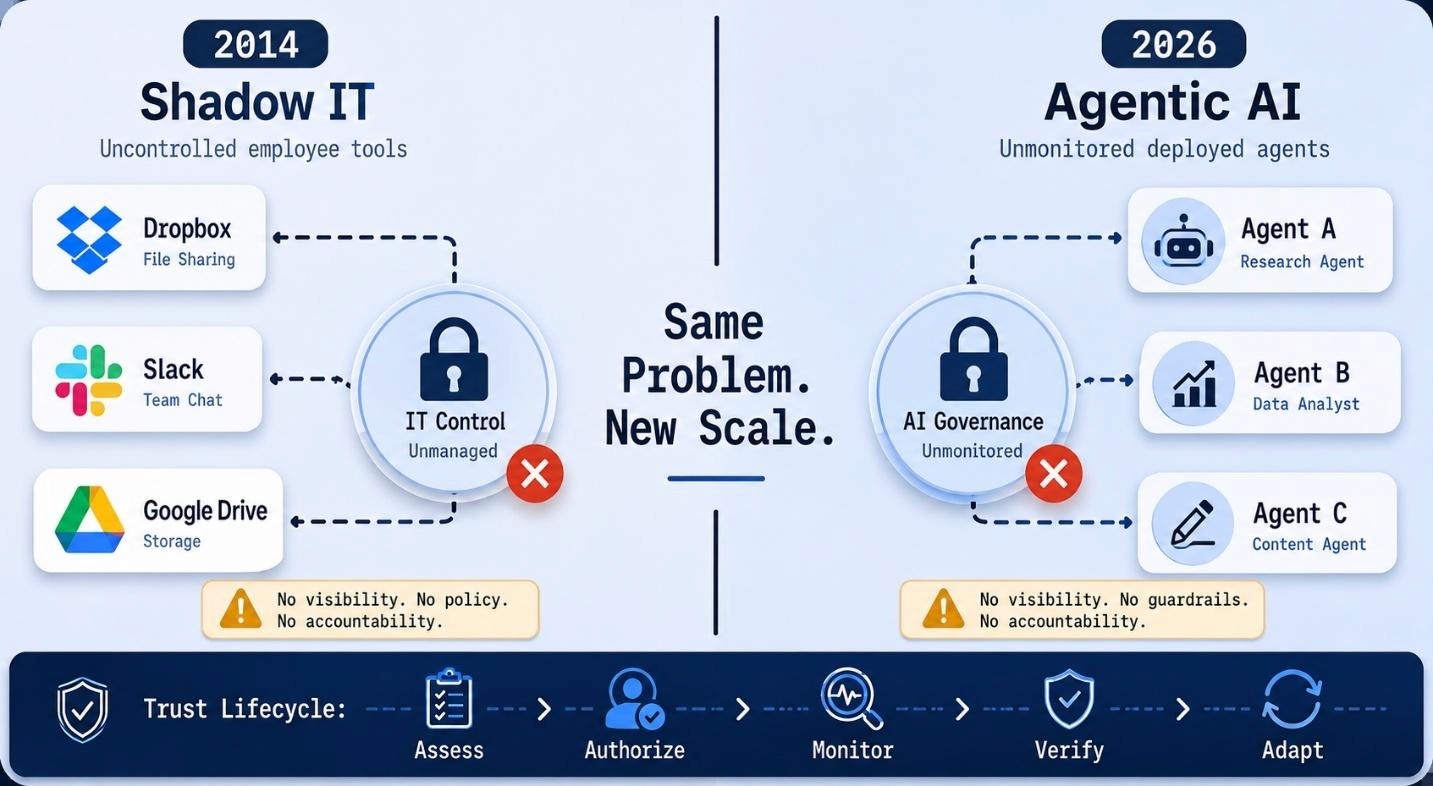
Consider the pattern that played out across enterprise organizations in the early 2010s. By the mid-2010s, most enterprises had already lost the battle they did not know they were fighting. Employees were syncing files to Dropbox, running projects in Trello, and routing sensitive conversations through personal Gmail accounts. IT had approved none of it. Security had visibility into none of it. And leadership had sanctioned none of it.
That was shadow IT: unauthorized technology proliferating inside organizations faster than governance could respond. The tools were useful, the intent was benign, and the risk was systemic. By the time most security teams understood the exposure, the footprint was already massive.
The playbook for containing shadow IT eventually stabilized: discover what exists, classify the risk, enforce policy at the access layer, and audit what moves through the system. It took years and cost enterprises significantly in remediation, compliance penalties, and architectural rework.
In 2026, the same pattern is repeating. The tools are different. The stakes are higher. And the window to respond is shorter.
What Agentic Shadow IT Looks Like
Across enterprise organizations today, teams are deploying autonomous AI agents to handle real operational work: processing invoices, executing API calls, querying internal databases, managing customer communications, and triggering downstream workflows. These agents are not running in controlled sandbox environments. They are running in production, against live systems, with real permissions.
Most of these deployments share a set of properties that should be immediately recognizable to anyone who lived through the shadow IT era:
They were deployed by a team, not governed by a platform.
They operate with credentials and access rights that IT did not formally review.
Their behavior is not continuously monitored in any structured sense.
When something goes wrong, there is no audit trail that reconstructs what happened and why.
No one has formally assessed their risk posture against documented parameters.
The velocity of deployment is the compounding factor. Individual teams are shipping agents in days using frameworks like LangGraph, Mastra, Temporal, and LangChain. The marginal cost of standing up a new agent is low. The marginal cost of governing it (if no governance infrastructure is already in place) is high enough that most teams skip it entirely.
This is how shadow IT spread. Not through malice. Through convenience, time pressure, and the absence of governance tooling that was fast enough to keep up with the deployment rate.
The data confirms the pattern is already underway. Gartner forecasts 40% of enterprise applications will integrate task-specific AI agents by end of 2026, up from less than 5% in 2025. A 2026 Gravitee State of AI Agent Security survey found that only 14.4% of organizations have achieved full security and IT approval for their entire agent fleet, meaning 85.6% are operating a governance gap matching the shadow IT problem of a decade ago, at higher operational velocity and with a significantly larger blast radius per incident.
Why Agentic AI is a Harder Problem
Shadow IT was dangerous because unauthorized tools could exfiltrate data, create compliance gaps, or introduce supply chain vulnerabilities. Those are serious risks. But the tools themselves were largely passive: they stored files, managed tasks, and relayed messages. A human was still in the decision loop for anything consequential.
Autonomous agents are different in kind, not just degree. They take actions. They make decisions across multi-step workflows without waiting for human input. An agent authorized to process financial transactions can execute dozens of operations in the time it takes a human reviewer to open a dashboard. An agent with access to internal systems can query, modify, or relay data at a rate that no manual audit process can track in real time.
The governance gap is structural. You cannot manage agentic AI risk by reviewing logs after the fact. By the time a post-hoc audit surfaces a problem, the agent has already acted. The governance layer must be embedded into execution, not applied afterward. Regulatory frameworks reinforce this: the EU AI Act (Article 14) mandates human oversight for high-risk AI systems (Annex III compliance expected December 2027, per the May 2026 Digital Omnibus revision), and the NIST AI RMF GOVERN function requires continuous AI monitoring throughout the operational lifecycle.
OpenBox (docs.openbox.ai) OpenBox wraps existing agents with a Trust Lifecycle: Assess, Authorize, Monitor, Verify, Adapt. Core constructs are Trust Scores, Trust Tiers, Guardrails, and Policies. The platform is designed for enterprises deploying agents in production. |
The Governance Gap is a Systems Coordination Problem
Most enterprises approaching agentic AI governance make the same structural error: they treat it as a policy problem when it is actually a systems coordination problem.
Writing a policy that says "agents must not access PII without authorization" is straightforward. Enforcing that policy at runtime, across every agent session, in every orchestration framework, with a complete audit trail, is a systems engineering challenge. The policy exists on paper. The enforcement has to exist in the execution layer.
This distinction matters because most governance approaches stop at the policy layer. They define rules, distribute guidelines, and perform periodic reviews. None of that reaches the runtime. An agent operating inside a LangGraph workflow or a Temporal workflow does not consult a governance document before executing a tool call. It executes according to whatever constraints are embedded in the system it runs on.
Governance that does not reach runtime systems is not governance. It is documentation.
What Structured Agent Governance Requires
OpenBox organizes agent governance around a five-phase Trust Lifecycle: Assess, Authorize, Monitor, Verify, Adapt. Each phase addresses a specific failure mode in the governance gap.
Assess: Quantifying Risk Before Deployment
Before deployment, OpenBox evaluates an agent’s inherent risk posture. Per OpenBox documentation (docs.openbox.ai), the Risk Profile Score is computed across 14 parameters: Base Security (25%), AI-Specific (45%), and Impact (30%). Higher scores indicate lower inherent risk. This produces a Risk Profile Score from 0 to 100 and a Risk Tier (1 to 4). The composite Trust Score, incorporating all three components, determines the Trust Tier that governs the agent’s operational autonomy.
The Risk Profile Score is static unless formally re-assessed. Separating this static risk assessment from the dynamic Behavioral and Alignment components is what makes the overall Trust Score coherent: the Risk Profile anchors the calculation to the agent's structural properties, while the runtime components capture how the agent actually behaves once deployed.
The component weights and what each captures are shown in the table below.
Trust Score Component | What It Captures |
Risk Profile Score (40%) | Inherent risk profile from Assess phase (static unless re-assessed) |
Behavioral Score (35%) | Runtime policy compliance from Authorize and Monitor phases |
Alignment Score (25%) | Goal consistency from the Verify phase, updated per session |
Authorize: Enforcing Constraints at Runtime
Authorization in OpenBox is not only an approval workflow for human operators. It is a runtime enforcement layer that evaluates every agent action against three distinct mechanisms: Guardrails, Policies, and Behavioral Rules; human approval is one of several possible governance decisions, not the primary mechanism.
Guardrails are pre- and post-processing rules that validate and transform agent inputs and outputs. Policies are OPA/Rego stateless permission checks. Behavioral Rules provide stateful multi-step pattern detection. Together, these produce four possible governance verdicts: ALLOW, BLOCK, HALT, or REQUIRE_APPROVAL.
The separation of these mechanisms is significant. Stateless policy checks handle cases where a single action can be evaluated in isolation. Stateful behavioral rules handle cases where a pattern of behavior across multiple steps constitutes the violation. An agent that queries a database once may be within policy. An agent that queries the same database sixty times in ten minutes may be violating a behavioral rule, even if each individual query would pass a stateless policy check.
Monitor: Continuous Observability
Monitoring is where most enterprise governance efforts currently stop. They instrument agents, collect telemetry, and build dashboards. This is necessary but not sufficient.
OpenBox's Monitor phase feeds into the Behavioral Score component, which carries a 35% weight in the overall Trust Score. When a behavioral violation occurs at runtime, it affects the Behavioral Score component. Per OpenBox documentation, minor violations apply a five-point penalty to the Behavioral component; major violations apply 15 points; critical violations apply 25 points. This means runtime behavior has a mathematically governed impact on the trust signals that determine what the agent is permitted to do going forward.
Monitoring without enforcement is observation. The governance value comes from the connection between what is observed and what happens next.
Verify and Adapt: Closing the Loop
The Verify phase provides post-hoc verification of agent decisions, including Session Replay, which allows governance teams to replay and audit agent sessions. The Adapt phase closes the governance loop by enabling policies to be updated based on observed behavior.
Score recovery is governed per OpenBox documentation: agents in Trust Tiers 1 through 3 recover at one point per day; agents in Tier 4 recover at 0.5 points per day. Recovery requires consecutive compliance across observable dimensions: no violations for seven or more days, high compliant operation volume, Human-in-the-Loop approvals, and consistent goal alignment scores.
The Trust Tier Structure
Trust Tiers translate the composite Trust Score (0–100) into five classification levels that determine how strictly an agent is controlled. Higher Trust Score = higher tier (lower number) = more operational autonomy. The official tier definitions, per OpenBox documentation (docs.openbox.ai/core-concepts/trust-tiers), are shown in the table below.
Trust Score (0–100) | Tier and Official Label |
90 to 100 | Tier 1: Trusted. Long history of compliance; minimal constraints. |
75 to 89 | Tier 2: Confident. Generally compliant; standard policy enforcement. |
50 to 74 | Tier 3: Monitor. New or recovering agents; enhanced controls. |
25 to 49 | Tier 4: Restrict. Pattern of non-compliance; strict governance with mandatory HITL. |
0 to 24 | Untrusted: Decommission. Agent suspended; cannot operate. |
A new agent starts with Behavioral and Alignment components both at 100. The composite Trust Score (as described above) is the full picture of how trustworthy an agent is at any point in time.
The tier structure makes governance decisions tractable at scale. Rather than applying uniform controls to every agent, governance teams concentrate oversight on Tier 3, Tier 4, and Untrusted agents while allowing Tier 1 and Tier 2 agents to operate with proportionally lighter controls.
The Audit Trail Problem
One of the most expensive lessons from the shadow IT era was that the absence of audit trails transformed every incident into an investigation with no evidence. Security teams knew that unauthorized tools had been used, that data had moved, that something had gone wrong. They often could not reconstruct exactly what, or prove it to a regulator who needed documented evidence.
OpenBox records every governance decision in an immutable audit trail. Each governance event contains the timestamp, agent identifier, event type, verdict issued (ALLOW, BLOCK, HALT, or REQUIRE_APPROVAL), the reason for that verdict, workflow and run identifiers for tracing, and approval metadata including who approved or denied the action and when.
The Trust Score history is also maintained: every change records the score before and after, the tier before and after, the type of change, the reason for the change, and what system or user triggered the evaluation.
Each session's governance events are cryptographically signed, producing a tamper-evident cryptographic audit trail. This is the difference between a compliance record that can be questioned and evidence whose integrity can be verified.
Per OpenBox documentation, the organization-level audit log tracks administrative and operational events across multiple categories, including Policy Changes, Guardrail Changes, Role Changes, Security Events, and Member Management. Export is available in CSV and Excel formats on demand, with configurable date ranges and event type filters.
Compliance Readiness Sound governance practice includes: quarterly policy reviews with documented rationale for any changes, periodic control validation testing, regular audit log exports, and team training on trust scores, governance verdicts, and approval workflows before operating agents in production. |
The Shadow IT Parallel Is Structural, Not Rhetorical
The shadow IT comparison is not a rhetorical device. The operational structure of the problem is the same.
In both cases, useful technology is being deployed faster than governance infrastructure can keep up. In both cases, the risk is distributed across a large number of independently operated instances rather than concentrated in a single system. In both cases, the absence of visibility is the primary driver of risk, not the technology itself.
The differences are in the severity of the failure modes and the difficulty of remediation. When an unauthorized SaaS tool was discovered in 2015, the response was to revoke access and enforce SSO. The damage was bounded. When an autonomous agent operating without governance infrastructure mishandles PII, executes unauthorized financial transactions, or makes decisions that cannot be audited, the damage is active and ongoing for as long as the agent runs.
The remediation is also harder. Shadow IT could be addressed by centralizing authentication. Agentic AI governance requires embedding enforcement into the execution layer of every orchestration framework the organization uses, across every agent that has been deployed, with a complete audit trail that satisfies both internal review and external compliance requirements.
Shadow IT spread because governance could not keep up with deployment velocity. Agentic AI is spreading for exactly the same reason.
The Cost of Waiting
The lesson of shadow IT is that late discovery compounds the cost of remediation. The longer unauthorized tools operated undetected, the larger the data exposure, the more complex the cleanup, and the more expensive the compliance response.
The same dynamic applies here. Every agent that operates without formal risk assessment, runtime authorization enforcement, and immutable audit trail generation is a governance liability that compounds over time. The sessions accumulate. The actions accumulate. The audit gap accumulates.
Late-stage compliance is expensive. The enterprises that governed shadow IT proactively (those that implemented SSO, classified SaaS tools by risk, and enforced policy at the identity layer before the footprint became unmanageable) paid a fraction of what remediation cost their peers.
The organizations that will manage agentic AI risk effectively are the ones that embed governance infrastructure now, before the agent fleet is too large and too distributed to instrument retroactively.
The cost of delayed governance is no longer theoretical. IBM’s 2025 Cost of a Data Breach Report found that, among organizations experiencing a data breach, those with high shadow AI involvement faced total costs averaging $670,000 more than those with minimal or no shadow AI activity. That figure does not account for the regulatory exposure, audit remediation costs, or reputational consequences that come with demonstrably absent governance infrastructure. The enterprises that govern early pay for the infrastructure. The ones that wait pay for the incident response.
Frequently Asked Questions
What is agentic shadow IT?
Agentic shadow IT refers to autonomous AI agents deployed inside an organization without formal IT review, security assessment, or governance oversight. Unlike traditional shadow IT (which involved passive tools that stored or relayed information), agentic shadow IT involves systems that take independent actions, execute multi-step workflows, and interact with live production data and APIs. The governance gap is structural: these agents operate continuously in environments that have no runtime enforcement layer to audit or constrain their behavior.
How is agentic AI governance different from traditional IT governance?
Traditional IT governance operates at the access layer: control who can use a tool, audit what they did after the fact. Agentic AI governance requires enforcement at the execution layer: before actions take effect. An autonomous agent does not wait for a human reviewer before calling an API or modifying a database record. Governance must be embedded in the runtime, evaluated per action, and recorded in a tamper-evident audit trail.
What is a Trust Score in AI agent governance?
A Trust Score is a 0–100 metric of agent trustworthiness derived from three components: Risk Profile Score (40%), Behavioral Score (35%), and Alignment Score (25%). Formula: Trust Score = (Risk Profile Score × 40%) + (Behavioral Score × 35%) + (Alignment Score × 25%). The Risk Profile Score reflects inherent risk and is static unless re-assessed. The Behavioral and Alignment components update dynamically based on runtime behavior. The composite Trust Score determines the agent’s Trust Tier and associated governance controls.
What governance controls do enterprises need for AI agents?
Effective AI agent governance requires four capabilities: formal risk assessment before deployment (assigning a Risk Tier), runtime policy enforcement at execution time, continuous behavioral monitoring, and immutable audit trail generation. Governance addressing only some of these layers leaves exploitable gaps. Audit logs without runtime enforcement mean violations are discovered after harm occurs. Runtime enforcement without audit trails cannot demonstrate compliance to external reviewers.
How does OpenBox address the agentic shadow IT problem?
OpenBox wraps existing agents with the five-phase Trust Lifecycle without architectural changes. It integrates via a single SDK with LangGraph, Mastra, Temporal, LangChain, and other frameworks. At runtime, OpenBox evaluates every action against Guardrails, OPA/Rego Policies, and Behavioral Rules, issuing one of four governance decisions (ALLOW, BLOCK, HALT, REQUIRE_APPROVAL) before execution. Every decision is recorded in a cryptographically signed, tamper-evident audit trail. Agents already in production can be governed without re-architecture, directly addressing the remediation problem that made late-stage shadow IT cleanup so expensive.
Conclusion: The Architecture of Governance
Shadow IT was a distribution problem. The technology was not the threat; the lack of visibility and control was. Enterprises that solved it did not do so by banning cloud tools. They did so by building the infrastructure (identity management, access controls, audit logging) that made it possible to govern what was already deployed.
Agentic AI requires the same approach, applied at a different layer of the stack. The agents are already deployed. More are being deployed every week. The question is not whether to govern them but whether the governance infrastructure exists to do it at runtime, with complete audit trails, and with enforcement that reaches the execution layer.
OpenBox's Trust Lifecycle (Assess, Authorize, Monitor, Verify, Adapt) addresses exactly this architecture: quantifying inherent risk through formal assessment, enforcing constraints through Guardrails, Policies, and Behavioral Rules, connecting runtime behavior to mathematically governed Trust Scores, and recording every governance decision in an immutable, cryptographically signed audit trail.
The parallel to shadow IT is not a warning about what might happen. It is a description of what is already happening. The governance infrastructure needs to catch up before the gap between deployment velocity and oversight capacity becomes unmanageable, because that is precisely what happened last time.
About OpenBox
OpenBox is an AI agent governance platform providing trust scoring, behavioral guardrails, policy enforcement, real-time monitoring, and cryptographic audit trails for autonomous AI agents. Designed for enterprises deploying agents in production.
docs.openbox.ai | contact@openbox.ai